Morbidly Adherent Placenta in an Unscarred Nigerian Uterus: A Case Report and Review of Literature.
Keywords:
Morbidily adherent placenta,, maternal , mortality, morbidity, DELSUTHAbstract
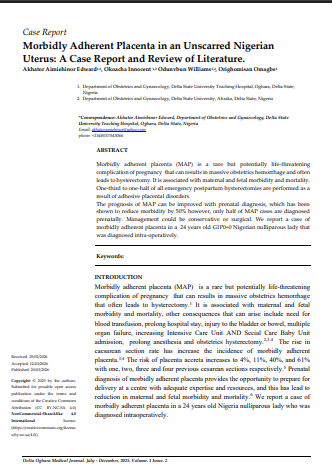
Morbidly adherent placenta (MAP) is a rare but potentially life-threatening complication of pregnancy that can results in massive obstetrics hemorrhage and often leads to hysterectomy. It is associated with maternal and fetal morbidity and mortality. One-third to one-half of all emergency postpartum hysterectomies are performed as a result of adhesive placental disorders.
The prognosis of MAP can be improved with prenatal diagnosis, which has been shown to reduce morbidity by 50% however, only half of MAP cases are diagnosed prenatally. Management could be conservative or surgical. We report a case of morbidly adherent placenta in a 24 years old G1P0+0 Nigerian nulliparous lady that was diagnosed intra-operatively.
Downloads
References
Gelany S, Ibrahim EM, Mohammed M, Abdelraheim AR et al. Management of bleeding from morbidly adherent placenta during elective repeat caesarean section : retrospective -record -based study. BMC Pregnancy and Childbirth 2019;4:1–7.
ABIDA S, AQSAM S, ARHAM A, MAHAM A. MORBIDLY ADHERENT PLACENTA: Postgrad Med J 2020; 31(1):3 - 7.
Ukah EC, Okhionkpamwonyi O, Okoacha I, Okonta PI. A 5 years review of hysterectomy at the Delta State University Teaching Hospital, Oghara, Southsouth Nigeria. IBOM Med J 2023;16(3):268-72.
Okhionkpamwonyi O, Okonta PI. Total abdominal hysterectomy at Central Hospital, Warri. A five year review. Borno Med J 2015;12(1):23-29
Khanum T, Ara G, Begum S, Miah MZ, Akter S. Morbid Adherent Placenta among Pregnant Women prior to Cesarean Delivery : Experience of 15 Cases at a Tertiary care Hospital in Bangladesh.jninb 2020;6(1):33–7.
Bhide A, Sebire N, Abuhamad A et al. Morbidly adherent placenta: The need for standardazation. Human Reproduction 2021:1–19.
Vyas R, Patel P, Shah S, Vala S, Patel N. Morbidly adherent placenta : management is real challenge. Int J Reprod Contrcept Obstet Gynecol 2019;8(3):1091–5.
Taskeen R, Shahwar D, Rafique I et al. Reducing Mortality and Morbidity in Morbidly Adherent Placenta. PJMHS 2022;16(02):935–7.
Tabir N, Adil M, Afzal B et al.. D E F I N I T I V E M A N A G E M E N T O F M O R B I D L Y A D H E R E N T P L A C E N T A : A N A L Y S I S O F MATERNAL OUTCOMES. Pak Armed Forces Med J 2018;68(5):1156–60.
Meyer NP, Ward GH, Chandraharan E. Conservative approach to the management of morbidly adherent placentae. Ceylon Medical Journal 2011;57(2):36–9.
Valentini AL, Russo L, Bonomo L. The morbidly adherent placenta: when and what association of signs can improve MRI diagnosis? Our experience.Turkish Society of Radiology 2017;4:180–6.
Okoacha I, Okhionkpamwonyi O, Okonta PI. A comparism of the effect of placental extraction from exteriorized versus non – exteriorized uterus on blood loss during caesarean section in Nigerian women. Afri J Reprod Health 2023;27(9):65-75.
Downloads
Published
Issue
Section
Categories
License
Copyright (c) 2026 Delta Oghara Medical Journal

This work is licensed under a Creative Commons Attribution-NonCommercial 4.0 International License.
This work is licensed under the Creative Commons Attribution-NonCommercial-ShareAlike 4.0 International License (CC BY-NC-SA 4.0). You are free to share and adapt the material for non-commercial purposes, provided appropriate credit is given to the author(s) and Delta Oghara Medical Journal, a link to the licence is provided, and any adapted material is distributed under the same licence.
Licence link: